
Cornell Scientists Build a Compact, Non-CRISPR Tool That Inserts Whole Stretches of DNA
On October 1, 2026, researchers at Cornell University reported in Molecular Cell a new way to insert large pieces of DNA at a chosen spot in a genome. The system is built from bacterial proteins that do not normally work together, and it does not use a CRISPR-Cas protein to find its target.
The work was done in bacteria, so it is not a treatment. But it addresses one of the biggest gaps in gene editing today: inserting whole genes, not just fixing single letters, and doing it accurately with a tool small enough to deliver.
The gap in today's gene editing
Most gene-editing tools in the clinic do one of three things:
CRISPR-Cas9 nucleases cut both strands of DNA. The cell's repair process often adds or removes a few letters, which is useful for switching a gene off.
Base editors chemically change one DNA letter into another without a double-strand break.
Prime editors write a short new sequence, usually a few letters up to a few dozen, from an RNA template.
None of these is well suited to inserting thousands of letters, such as a full working gene. Many genetic diseases can be caused by hundreds of different mutations in the same gene. Inserting one healthy copy could, in principle, treat all of those patients with a single product, rather than designing a separate edit for each mutation.
Cutting DNA and supplying a repair template can insert large sequences, but that approach relies on repair pathways that work poorly in most adult, non-dividing cells, and it can create unwanted changes at the cut site.

What transposons offer
Transposons are DNA sequences that move from one place in a genome to another. They encode enzymes called transposases that cut the transposon out and insert it somewhere new, without relying on the cell's break-repair machinery.
Tn7 is unusual among transposons because it chooses where it lands instead of inserting at random. One of its proteins recognizes a specific sequence in the bacterial chromosome and recruits the insertion machinery to that spot. The TniQ protein family plays a central part in linking target recognition to insertion in these systems.
Some bacterial transposons in the Tn7 family evolved to use CRISPR systems to choose where they land. These CRISPR-associated transposons, studied in Joseph Peters' lab at Cornell and by other groups, can insert large DNA payloads at a site defined by a guide RNA. Their drawback is size. They need several large proteins, which makes them hard to package into delivery vehicles such as AAV vectors, which hold only about 4,700 DNA letters.
What the Cornell team built
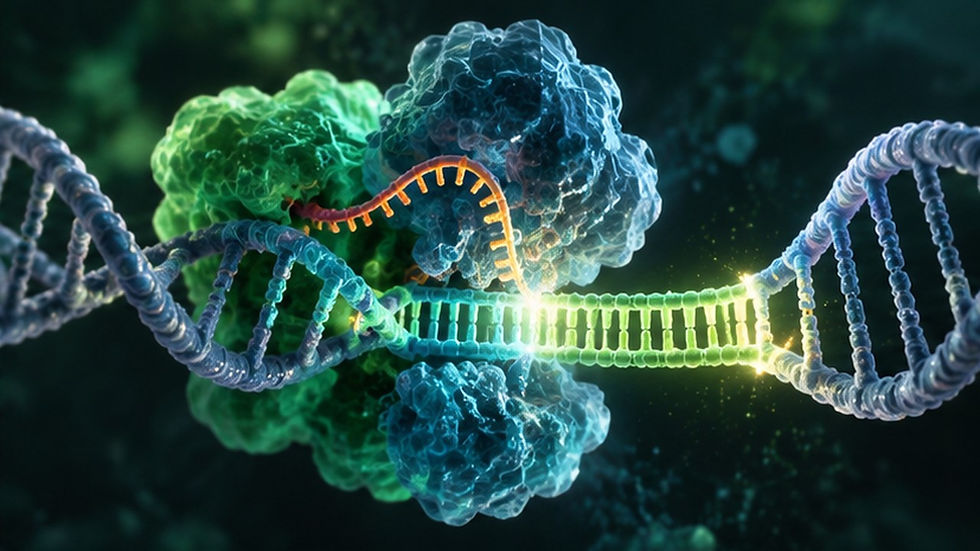
The new system replaces the bulky CRISPR targeting module with a smaller one. The paper, "De novo-engineered guide RNA-directed transposition with TnpB-family proteins," combines two components:
TldR, an RNA-guided DNA-binding protein from the TnpB family. TnpB proteins are considered evolutionary ancestors of the Cas12 family of CRISPR enzymes. TldR uses a guide RNA to find its target sequence.
TniQ, a protein from Tn7-like transposons that connects target recognition to the insertion machinery and helps place the payload in one fixed orientation.
In nature, these parts do not occur together. "We took these vastly different kinds of components and we fused them together," said senior author Joseph Peters, professor of microbiology at Cornell's College of Agriculture and Life Sciences.
The result is a programmable insertion system that is much smaller than CRISPR-Cas systems. "You want things that are smaller and with fewer components because it makes delivery easier for editing technology," Peters said.
The team reported that the system placed its payload more accurately, lowering the chance of insertion at the wrong site. In a related set of experiments, the researchers also used what they learned to improve the efficiency and accuracy of an existing CRISPR-Cas transposition system.
Why orientation and accuracy matter
When a gene is inserted, direction matters. A gene placed backward relative to the sequences that should switch it on may not be expressed properly. A system that consistently inserts in one orientation makes results more predictable.
Accuracy matters even more for safety. An insertion in the wrong place could disrupt a needed gene or switch on a gene that should stay off, such as one that drives cell growth. Early gene therapies that used integrating viral vectors showed how serious this risk can be when insertion sites are not controlled. A tool that writes large DNA only at a chosen address would avoid much of that risk.
Payload size matters too. A therapeutic gene, together with the sequences needed to switch it on at the right level, often runs to several thousand DNA letters. Tools that write only a few dozen letters cannot deliver that.
What still has to happen
The study was done entirely in bacteria. Bacterial systems often work poorly in human cells, which pack their DNA tightly into chromatin inside a nucleus.
The team noted that the system will need additional specialized components to work in plant or human cells. They are now testing a broader family of related proteins, of which TldR is one subgroup, to look for versions that perform well in those cells. Cornell has filed a patent application.
Other groups are pursuing the same goal with different tools, including recombinases paired with prime editing and bridge RNA systems. It is too early to say which approach will reach patients first. For comparison, see how prime editing writes small corrections in Prime Medicine Seeks FDA Approval for the First Prime-Editing Therapy.
"You can program it to put in a huge block of DNA in a new location, and that's got the field very excited," Peters said.
The bottom line
Cornell researchers combined two unrelated bacterial proteins into a compact, RNA-guided system that inserts large DNA segments at a chosen site in one orientation, without a CRISPR-Cas protein. It works only in bacteria so far, but a small, accurate gene-insertion tool could one day let a single therapy replace a faulty gene regardless of which mutation a patient carries.
Watch the 30-second Short
Watch on YouTube: A CRISPR alternative that inserts whole genes?
Keep exploring with Gene Tech Times
Free guide: subscribe to the Gene Tech Times Briefing on our homepage and get Every FDA-Approved Gene Therapy at a Glance in your inbox.
Watch: 30-second gene therapy Shorts on Gene Tech Times Academy.
Read: The Cheat Codes of Our Genes, real stories of mutations that make some people immune to disease.
New to gene therapy? Start with The Life-Changing Power of Gene Therapy.
As an Amazon Associate, Gene Tech Times earns from qualifying purchases.
— T.N., Gene Tech Times


Comments