
Grace Science's GS-100 Earns RMAT Designation for NGLY1 Deficiency
Updated: 1 day ago
In April 2026, GS-100, an AAV9 gene replacement therapy from Grace Science for NGLY1 deficiency, received Regenerative Medicine Advanced Therapy (RMAT) designation from the FDA. The designation came with an encouraging update: children treated and followed for at least 52 weeks "have shown gains in motor function and cognitive skills.
That's a notable sentence for a disease most people, and many doctors, have never heard of. NGLY1 deficiency was first described in 2012. The story of how it went from unknown to the subject of a clinical trial is one of the great examples of patient families driving science forward.
A cellular recycling job left undone
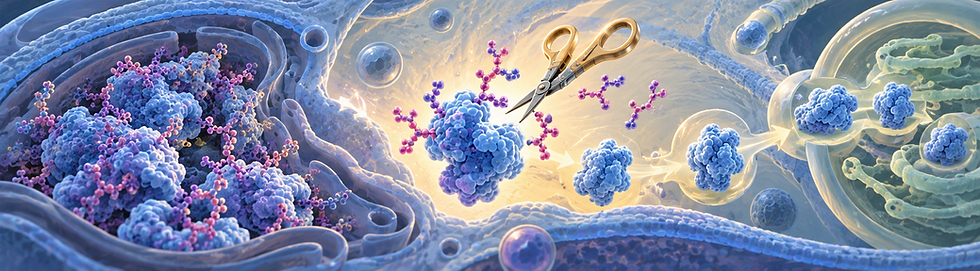
Our cells constantly make proteins, and many of them are decorated with sugar chains called glycans. When a protein is misfolded or worn out, the cell sends it to be broken down and recycled. Before that can happen, the sugar decorations need to come off.
That's the job of an enzyme called N-glycanase 1, made from the NGLY1 gene. It clips the sugar chains off proteins so they can be processed. When both copies of NGLY1 are broken, this cleanup step fails. The effects reach many systems, but the nervous system is hit especially hard.
Children with NGLY1 deficiency typically have:
• Global developmental delay and intellectual disability
• A movement disorder, with involuntary movements
• Reduced or absent tears (alacrima), a feature that helped doctors recognize the condition
• Liver problems and low muscle tone
• Seizures in some cases
There is currently no approved treatment. Care focuses on managing symptoms.
The treatment: a spaceship aimed at the whole nervous system
GS-100 is a gene replacement therapy. Rather than editing the broken gene, it adds a working copy of NGLY1 so cells can make the enzyme themselves. If gene therapy is a Master Chef, this is the simplest possible recipe fix: bring a clean copy of the page that's missing from the cookbook.
The delivery vehicle is AAV9, one of the most widely used viral vectors in gene therapy. Picture AAV9 as a spaceship engineered for a particular destination. Its big advantage is that it can reach the central nervous system, including neurons, which is essential for a disease whose worst symptoms are neurological. AAV9 is the same capsid used in Zolgensma, the approved gene therapy for spinal muscular atrophy, so there's a substantial safety track record to learn from.

Once inside the cell, the NGLY1 gene typically stays as a separate loop of DNA rather than integrating into the chromosome. Because neurons don't divide, that loop can keep producing the enzyme for a long time.
What RMAT designation means
The RMAT designation was created under the 21st Century Cures Act for cell and gene therapies aimed at serious conditions. To qualify, a therapy needs preliminary clinical evidence suggesting it could address an unmet medical need.
RMAT gives developers practical advantages:
• Early, frequent meetings with the FDA to discuss development plans
• Eligibility for priority review and accelerated approval
• Flexibility to discuss surrogate or intermediate endpoints that may predict clinical benefit
RMAT is not an approval. It's a signal that the FDA sees enough early promise to work more closely with the sponsor. For a company developing a therapy for a disease this rare, that close guidance can save years.
What the data suggest so far
Grace Science reported that treated participants followed for at least 52 weeks showed gains in motor function and cognitive skills. In May, the company presented more interim findings from its phase 1/2/3 trial. These showed "early improvements in motor and cognitive function" and dose-dependent safety results that are informing dosing for the pivotal part of the study.
Some caution is warranted. The number of patients is small, and in a pediatric neurological disease, children are also developing naturally over time. Separating treatment effects from normal development requires careful comparison with natural history data, meaning how untreated children with the same condition progress. Still, for a condition with no approved therapy, gains in motor and cognitive skills are exactly what families hope to see.
A family-powered story
NGLY1 deficiency has a special place in rare-disease history. After the first patients were identified through genome sequencing, their parents reached out to other families online, organized research funding, and helped recruit scientists to study the disease. Grace Science itself is named for Grace Wilsey, one of the first children diagnosed.
That model, where parents map the disease, build the registry, and fund early research, has since been copied by many other rare-disease communities. GS-100's progress is a direct payoff of that effort.
The bottom line
GS-100 is still in clinical trials, and much depends on what the pivotal stage shows. But RMAT designation and early gains in motor and cognitive skills put a gene therapy for NGLY1 deficiency on a faster track than anyone might have predicted when the disease was first named just over a decade ago.
Keep exploring with Gene Tech Times
Free guide: subscribe to the Gene Tech Times Briefing on our homepage and get Every FDA-Approved Gene Therapy at a Glance in your inbox.
Watch: 30-second gene therapy Shorts on Gene Tech Times Academy.
Read: The Cheat Codes of Our Genes, real stories of mutations that make some people immune to disease.
New to gene therapy? Start with The Life-Changing Power of Gene Therapy.
— T.N., Gene Tech Times


Comments